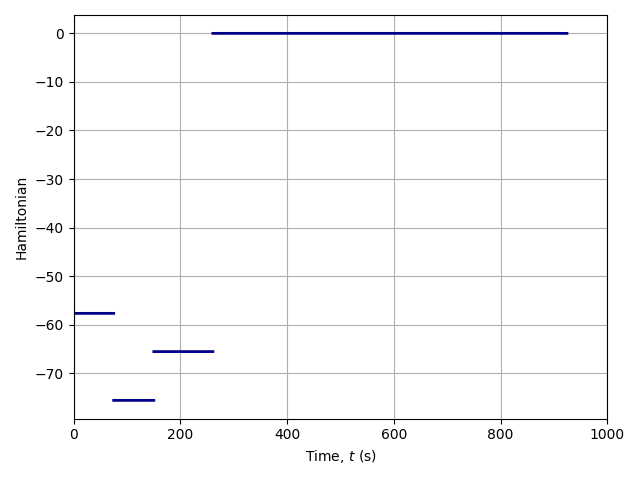
Delta III Launch Vehicle Ascent Problem
For a description of the minimum time to climb problem, see the JupyterLab notebook documentation for this problem.
The python script in this example can be executed from the command line with:
$ python -m yapss.examples.delta_iii_ascent
Functions
YAPSS solution of the Delta III ascent trajectory optimization problem.
- main() None[source]
Demonstrate the solution to the Delta III ascent trajectory optimization problem.
Code
"""

YAPSS solution of the Delta III ascent trajectory optimization problem.

"""

# N803 Argument name should be lowercase
# N806 Variable in function should be lowercase
# ruff: noqa: N803, N806

from __future__ import annotations

__all__ = ["main", "plot_solution", "setup"]

import warnings

# standard library imports
from typing import TYPE_CHECKING, Any

import numpy as np

# third party imports
from matplotlib import pyplot as plt

# package imports
from yapss import ContinuousArg, DiscreteArg, ObjectiveArg, Problem, Solution
from yapss.math import arccos, cos, exp, pi, sin, sqrt

if TYPE_CHECKING:
    # package imports
    from yapss import Solution


# Suppress only the specific RuntimeWarning message
warnings.filterwarnings(
    "ignore",
    message="invalid value encountered in divide",
    category=RuntimeWarning,
)

# Dynamic Model Parameters
mu = 3.986012e14  # earth gravity parameter
R_e = 6378145.0  # earth radius
g0 = 9.80665  # sea-level gravity
h0 = 7200.0  # atmospheric density scale height
rho0 = 1.225  # sea-level air density
omega_e = 7.29211585e-5  # earth rotation rate
CD = 0.5  # coefficient of drag
S = 4 * pi  # aerodynamic reference area
psi_l = 28.5 * pi / 180.0  # latitude of launch site
q_max = 100000.0  # dynamic pressure bound

# Vehicle parameters
# srb, first stage, second stage, payload masses (kg)
pi_s, pi_1, pi_2, pi_p = 19290.0, 104380.0, 19300.0, 4164.0

# propellant masses (kg)
rho_s, rho_1, rho_2 = 17010.0, 95550.0, 16820.0

# dry masses
phi_s = pi_s - rho_s
phi_1 = pi_1 - rho_1
phi_2 = pi_2 - rho_2

# srb, first stage, second stage thrust (N)
Ts, T1, T2 = 628500.0, 1083100.0, 110094.0

# burn times
tau_s, tau_1, tau_2 = 75.2, 261.0, 700.0

# initial total mass of vehicle
m_total = 9 * pi_s + pi_1 + pi_2 + pi_p

# initial time for each phase
t0, t1, t2, t3 = 0.0, 75.2, 150.4, 261.0

# max final time
t4_max = t3 + tau_2

# srb, first stage, second stage specific impulse (sec)
Is = Ts * tau_s / (rho_s * g0)
I1 = T1 * tau_1 / (rho_1 * g0)
I2 = T2 * tau_2 / (rho_2 * g0)

# orbital parameters for desired orbit
a_f, e_f, i_f, Omega_f, omega_f = 24361140, 0.7308, 28.5, 269.8, 130.5

# scaling parameters for IPOPT problem scaling
length_scale = R_e
mu_scale = mu
mass_scale = m_total
velocity_scale = sqrt(mu_scale / length_scale)
time_scale = length_scale / velocity_scale

state_scale = np.ones([7])
state_scale[:3] *= length_scale
state_scale[3:6] *= velocity_scale
state_scale[6] *= mass_scale

# initial position
r0_vec = R_e * cos(psi_l), 0.0, R_e * sin(psi_l)

mi_0 = 9 * pi_s + pi_1 + pi_2 + pi_p
mf_0 = mi_0 - 6 * rho_s - tau_s / tau_1 * rho_1

mi_1 = mf_0 - 6 * phi_s
mf_1 = mi_1 - 3 * rho_s - tau_s / tau_1 * rho_1

mi_2 = mf_1 - 3 * phi_s
mf_2 = mi_2 - (1 - 2 * tau_s / tau_1) * rho_1

mi_3 = mf_2 - phi_1


def cross(x1: Any, x2: Any) -> Any:
    """Vector cross product."""
    x3 = [0, 0, 0]
    x3[0] = x1[1] * x2[2] - x1[2] * x2[1]
    x3[1] = x1[2] * x2[0] - x1[0] * x2[2]
    x3[2] = x1[0] * x2[1] - x1[1] * x2[0]
    return x3


def mag(x: Any) -> Any:
    """Vector magnitude."""
    return (sum(xi**2 for xi in x) + 1e-100) ** 0.5


def dot(x1: Any, x2: Any) -> Any:
    """Vector _dot product."""
    return sum(x1[i] * x2[i] for i in range(3))


# noinspection PyPep8Naming
def oe_to_rv(  # noqa: PLR0913 (Too many arguments)
    a: Any,
    e: Any,
    i: Any,
    Omega: Any,
    omega: Any,
    nu: Any,
    mu_: Any,
) -> Any:
    """Convert orbital elements to cartesian position and velocity.

    Parameters
    ----------
    a: semimajor axis
    e: eccentricity
    i: inclination
    Omega: longitude of the ascending node (degrees)
    omega: argument of the periapsis (degrees)
    nu: true anomaly
    mu_: Gravitational parameter

    Returns
    -------
    Tuple[ArrayLike]: Inertial position and velocity vectors
    """
    p = a * (1 - e**2)
    r = p / (1 + e * cos(nu))
    r_vec = np.array([r * cos(nu), r * sin(nu), 0])
    v_vec = sqrt(mu_ / p) * np.array([-sin(nu), e + cos(nu), 0])
    deg_to_rad = pi / 180
    c_O = cos(deg_to_rad * Omega)
    s_O = sin(deg_to_rad * Omega)
    c_o = cos(deg_to_rad * omega)
    s_o = sin(deg_to_rad * omega)
    c_i = cos(deg_to_rad * i)
    s_i = sin(deg_to_rad * i)
    R = np.array(
        [
            [c_O * c_o - s_O * s_o * c_i, -c_O * s_o - s_O * c_o * c_i, +s_O * s_i],
            [s_O * c_o + c_O * s_o * c_i, -s_O * s_o + c_O * c_o * c_i, -c_O * s_i],
            [s_o * s_i, c_o * s_i, c_i],
        ],
    )
    r_vec = R @ r_vec
    v_vec = R @ v_vec
    return r_vec, v_vec


def setup() -> Problem:
    """Set up the Delta III ascent optimal control problem.

    Returns
    -------
    Problem
        The Delta III ascent optimal control problem.
    """
    ocp = Problem(
        name="Delta III Ascent Trajectory Optimization",
        nx=[7, 7, 7, 7],
        nu=[3, 3, 3, 3],
        nh=[2, 2, 2, 2],
        nd=23,
    )

    def objective(arg: ObjectiveArg) -> None:
        """Calculate Delta III ascent trajectory optimization problem objective.

        The Delta III ascent trajectory optimization problem objective is to maximize the
        total mass at the end of the trajectory.
        """
        arg.objective = -arg.phase[3].final_state[6]

    def continuous(arg: ContinuousArg) -> None:
        """Calculate Delta III ascent trajectory optimization problem dynamics and path constraints.

        The constraints are:
            * The magnitude of the thrust control vector must be identically one.
            * The altitude must always be greater than zero.
        """
        for p in arg.phase_list:
            state = arg.phase[p].state
            r1, r2, r3 = r_vec = state[0:3]
            v1, v2, v3 = v_vec = state[3:6]
            m = state[6]
            u1, u2, u3 = u_vec = arg.phase[p].control

            if p == 0:
                thrust = 6 * Ts + T1
                m_dot = -(6 * Ts / (g0 * Is) + T1 / (g0 * I1))
            elif p == 1:
                thrust = 3 * Ts + T1
                m_dot = -(3 * Ts / (g0 * Is) + T1 / (g0 * I1))
            elif p == 2:  # noqa: PLR2004
                thrust = T1
                m_dot = -T1 / (g0 * I1)
            elif p == 3:  # noqa: PLR2004
                thrust = T2
                m_dot = -T2 / (g0 * I2)
            else:
                raise ValueError  # pragma: no cover

            # kinematics
            r1_dot, r2_dot, r3_dot = v1, v2, v3

            # air density
            r = (r1**2 + r2**2 + r3**2) ** 0.5
            h = r - R_e
            rho = rho0 * exp(-h / h0)

            # aerodynamics
            omega_cross_r = cross([0, 0, omega_e], r_vec)
            vr_vec = [v_vec[i] - omega_cross_r[i] for i in range(3)]
            vr = mag(vr_vec)
            q_over_vr = 0.5 * rho * vr
            q_factor = q_over_vr * CD * S
            d1, d2, d3 = -q_factor * vr_vec[0], -q_factor * vr_vec[1], -q_factor * vr_vec[2]

            # dynamics
            mu_over_r3 = mu / r**3
            thrust_over_m = thrust / m
            one_over_m = 1 / m
            v1_dot = -mu_over_r3 * r1 + thrust_over_m * u1 + one_over_m * d1
            v2_dot = -mu_over_r3 * r2 + thrust_over_m * u2 + one_over_m * d2
            v3_dot = -mu_over_r3 * r3 + thrust_over_m * u3 + one_over_m * d3

            arg.phase[p].dynamics[:] = r1_dot, r2_dot, r3_dot, v1_dot, v2_dot, v3_dot, m_dot

            # path constraints
            arg.phase[p].path[:] = mag(u_vec), mag(r_vec)

    def discrete(arg: DiscreteArg) -> None:
        """Calculate the Delta III ascent trajectory optimization problem discrete constraints.

        The discrete constraints are that:
            * The final position and velocity of each phase are the same as the
              initial position and velocity at the next phase, if there is one.
            * The final position and velocity of the last phase is in the desired
              orbit.
        """
        phase = arg.phase
        arg.discrete[0:6] = phase[0].final_state[0:6] - phase[1].initial_state[0:6]
        arg.discrete[6:12] = phase[1].final_state[0:6] - phase[2].initial_state[0:6]
        arg.discrete[12:18] = phase[2].final_state[:6] - phase[3].initial_state[:6]
        x = phase[3].final_state
        r = x[:3]
        v = x[3:6]
        oe = rv_to_oe(r, v)
        arg.discrete[18:23] = oe

    ocp.functions.objective = objective
    ocp.functions.continuous = continuous
    ocp.functions.discrete = discrete

    def rv_to_oe(r_vec: Any, v_vec: Any) -> Any:
        r"""Compute orbital elements from position and velocity vectors.

        The function is a simplified calculation of (some of) the orbital elements, without
        checking for special cases.

        Parameters
        ----------
            r_vec : 3-dimensional position vector
            v_vec : 3-dimensional velocity vector

        Returns
        -------
        Tuple[int]
            Five of the six orbital elements: semimajor axis, eccentricity, inclination,
            longitude of the ascending node, argument of the periapsis
        """
        # http://www.aerospacengineering.net/determining-orbital-elements/
        r = mag(r_vec)
        v = mag(v_vec)
        h_vec = cross(r_vec, v_vec)
        h = mag(h_vec)
        n_vec = cross([0, 0, 1], h_vec)
        n = mag(n_vec)
        e0 = ((v**2 - mu / r) * r_vec[0] - dot(r_vec, v_vec) * v_vec[0]) / mu
        e1 = ((v**2 - mu / r) * r_vec[1] - dot(r_vec, v_vec) * v_vec[1]) / mu
        e2 = ((v**2 - mu / r) * r_vec[2] - dot(r_vec, v_vec) * v_vec[2]) / mu
        e_vec = (e0, e1, e2)
        e = mag(e_vec)
        a = 1 / (2 / r - v**2 / mu)
        i = arccos(h_vec[2] / h) * 180 / pi
        Omega = 360 - arccos(n_vec[0] / n) * 180 / pi
        omega = arccos(dot(n_vec, e_vec) / (n * e)) * 180 / pi
        return a, e, i, Omega, omega

    x0 = R_e * cos(psi_l), 0.0, R_e * sin(psi_l)
    v0 = [0.0, R_e * omega_e * cos(psi_l), 0.0]
    state_0 = 7 * [0.0]
    state_0[:3] = x0
    state_0[3:6] = v0
    state_0[6] = mi_0

    r_max = 2 * R_e
    v_max = 10000.0

    # 10 kg leeway on box bounds
    ten = 10

    # box bounds on position and velocity
    for p in range(4):
        bounds = ocp.bounds.phase[p]
        bounds.initial_state.lower[:6] = 3 * [-r_max] + 3 * [-v_max]
        bounds.initial_state.upper[:6] = 3 * [r_max] + 3 * [v_max]
        bounds.state.lower[:6] = 3 * [-r_max] + 3 * [-v_max]
        bounds.state.upper[:6] = 3 * [r_max] + 3 * [v_max]
        bounds.final_state.lower[:6] = 3 * [-r_max] + 3 * [-v_max]
        bounds.final_state.upper[:6] = 3 * [r_max] + 3 * [v_max]

    # phase 0 time and state bounds
    bounds = ocp.bounds.phase[0]
    bounds.initial_time.lower = bounds.initial_time.upper = t0
    bounds.final_time.lower = bounds.final_time.upper = t1
    bounds.initial_state.lower[:] = bounds.initial_state.upper[:] = state_0
    bounds.state.lower[6] = mf_0 - ten
    bounds.state.upper[6] = mi_0 + ten
    bounds.final_state.lower[6] = mf_0 - ten
    bounds.final_state.upper[6] = mi_0 + ten

    # phase 1
    bounds = ocp.bounds.phase[1]
    bounds.initial_time.lower = bounds.initial_time.upper = t1
    bounds.final_time.lower = bounds.final_time.upper = t2
    bounds.initial_state.lower[6] = bounds.initial_state.upper[6] = mi_1
    bounds.state.lower[6] = mf_1 - ten
    bounds.state.upper[6] = mi_1 + ten
    bounds.final_state.lower[6] = mf_1 - ten
    bounds.final_state.upper[6] = mi_1 + ten

    # phase 2
    bounds = ocp.bounds.phase[2]
    bounds.initial_time.lower = bounds.initial_time.upper = t2
    bounds.final_time.lower = bounds.final_time.upper = t3
    bounds.initial_state.lower[6] = bounds.initial_state.upper[6] = mi_2
    bounds.state.lower[6] = mf_2 - ten
    bounds.state.upper[6] = mi_2 + ten
    bounds.final_state.lower[6] = mf_2 - ten
    bounds.final_state.upper[6] = mi_2 + ten

    # phase 3
    bounds = ocp.bounds.phase[3]
    bounds.initial_time.lower = bounds.initial_time.upper = t3
    bounds.final_time.lower = t3
    bounds.final_time.upper = t4_max
    bounds.initial_state.lower[6] = bounds.initial_state.upper[6] = mi_3
    bounds.state.lower[6] = pi_p - ten
    bounds.state.upper[6] = mi_3 + ten
    bounds.final_state.lower[6] = pi_p
    bounds.final_state.upper[6] = mi_3 + ten

    # path and control constraints
    for p_ in range(4):
        ocp.bounds.phase[p_].path.lower[:] = 1, R_e
        ocp.bounds.phase[p_].path.upper[0] = 1
        ocp.bounds.phase[p_].control.lower[:] = -1.1
        ocp.bounds.phase[p_].control.upper[:] = +1.1

    # discrete constraints
    ocp.bounds.discrete.lower[:18] = ocp.bounds.discrete.upper[:18] = 0
    ocp.bounds.discrete.lower[18:23] = ocp.bounds.discrete.upper[18:23] = (
        a_f,
        e_f,
        i_f,
        Omega_f,
        omega_f,
    )
    # time guess
    ocp.guess.phase[0].time = (t0, t1)
    ocp.guess.phase[1].time = (t1, t2)
    ocp.guess.phase[2].time = (t2, t3)
    ocp.guess.phase[3].time = (t3, t4_max)

    for p in range(4):
        ocp.guess.phase[p].state = np.zeros([7, 2])
    # mass guess
    ocp.guess.phase[0].state[6] = (mi_0, mf_0)
    ocp.guess.phase[1].state[6] = (mi_1, mf_1)
    ocp.guess.phase[2].state[6] = (mi_2, mf_2)
    ocp.guess.phase[3].state[6] = (mi_3, pi_p)

    # position, velocity, and control guess
    for p_ in range(2):
        guess = ocp.guess.phase[p_]
        guess.state[:3] = 2 * (x0[0],), 2 * (x0[1],), 2 * (x0[2],)
        guess.state[3:6] = 2 * (v0[0],), 2 * (v0[1],), 2 * (v0[2],)
        guess.control = [[0.0, 0.0], [1.0, 1.0], [0.0, 0.0]]

    # terminal state
    temp = np.concatenate(oe_to_rv(a_f, e_f, i_f, Omega_f, omega_f, 0, mu))
    temp = np.array([temp, temp]).transpose()

    for p_ in range(2, 4):
        guess = ocp.guess.phase[p_]
        guess.state[:6] = temp
        guess.control = [[0.0, 0.0], [1.0, 1.0], [0.0, 0.0]]

    ocp.derivatives.method = "auto"
    ocp.derivatives.order = "second"
    ocp.ipopt_options.max_iter = 1000
    ocp.ipopt_options.print_level = 3

    # scales
    for p in range(4):
        ocp.scale.phase[p].state[0:3] = length_scale
        ocp.scale.phase[p].state[3:6] = velocity_scale
        ocp.scale.phase[p].state[6] = mass_scale
        ocp.scale.phase[p].dynamics[0:3] = length_scale
        ocp.scale.phase[p].dynamics[3:6] = velocity_scale
        ocp.scale.phase[p].dynamics[6] = mass_scale
        ocp.scale.phase[p].time = time_scale
        ocp.scale.phase[p].path[:] = 1, length_scale

        ocp.scale.phase[p].path[1] = length_scale / 2

    for p in range(3):
        ocp.scale.discrete[0 + 6 * p : 3 + 6 * p] = length_scale
        ocp.scale.discrete[3 + 6 * p : 6 + 6 * p] = velocity_scale
    ocp.scale.discrete[18] = length_scale

    ocp.scale.objective = 8_000

    # default mesh configuration is a bit slow for this problem
    m, n = 5, 5
    for p_ in range(4):
        ocp.mesh.phase[p_].collocation_points = m * (n,)
        ocp.mesh.phase[p_].fraction = m * (1.0 / m,)

    ocp.spectral_method = "lgl"
    ocp.ipopt_options.tol = 1e-20
    ocp.ipopt_options.constr_viol_tol = 1e-20
    ocp.ipopt_options.dual_inf_tol = 1e-20
    ocp.ipopt_options.compl_inf_tol = 1e-20

    return ocp


def plot_solution(solution: Solution) -> None:
    """Plot the solution.

    Parameters
    ----------
    solution : Solution
        The solution to the Delta III ascent trajectory optimization problem.
    """
    # extract the state, control, costate, dynamics, and time variables
    x = [solution.phase[p].state for p in range(4)]
    u = [solution.phase[p].control for p in range(4)]
    t = [solution.phase[p].time for p in range(4)]
    tu = [solution.phase[p].time_c for p in range(4)]

    # velocity for plotting
    v = 4 * [t]
    for phase in range(4):
        v[phase] = np.sqrt(x[phase][3] ** 2 + x[phase][4] ** 2 + x[phase][5] ** 2)

    # plot settings
    color = ("darkblue", "maroon", "darkorange")

    # mass
    plt.figure(1)
    for p in range(4):
        plt.plot(t[p], x[p][6])
    plt.ylabel("Vehicle mass, $m$ (kg)")
    plt.ylim([0, 300000])

    # control vector
    plt.figure(2)
    for p in range(4):
        for i in range(3):
            plt.plot(tu[p], u[p][i], color[i])
    plt.ylabel("Components of thrust direction vector, $u(t)$")
    plt.ylim([-0.8, 1.0])

    # velocity vector
    plt.figure(3)
    for phase in range(4):
        for i in range(3, 6):
            plt.plot(t[phase], x[phase][i] - x[0][i][0] * 0, color[i - 3])
    plt.ylabel("Components of inertial velocity, $v(t)$ (m/s)")

    # total velocity
    plt.figure(4)
    for phase in range(4):
        plt.plot(t[phase], v[phase], color[0])
    plt.ylabel("Magnitude of inertial velocity, $v(t)$ (m/s)")
    plt.ylim([0, 12000])

    # position vector
    plt.figure(5)
    for phase in range(4):
        for i in range(3):
            plt.plot(t[phase], x[phase][i] - x[0][i][0] * 0, color[i])
    plt.ylabel("Components of inertial position, $r(t)$ (m)")
    plt.legend([r"$r_{1}(t)$", r"$r_{2}(t)$", r"$r_{3}(t)$"])

    # altitude
    plt.figure(6)
    plt.clf()
    for phase in range(4):
        h = np.sqrt(sum(x[phase][i] ** 2 for i in range(3))) - R_e
        plt.plot(t[phase], h / 1000, color[0])
    plt.ylabel(r"Altitude, $h$ (km)")

    # hamiltonian
    plt.figure(7)
    plt.clf()
    for p in range(4):
        plt.plot(tu[p], solution.phase[p].hamiltonian, color[0], linewidth=2)
    plt.ylabel(r"Hamiltonian")

    # common figure elements
    for i in range(1, 8):
        plt.figure(i)
        plt.xlim([0, 1000])
        plt.xlabel("Time, $t$ (s)")
        plt.grid(visible=True)
        plt.tight_layout()


def main() -> None:
    """Demonstrate the solution to the Delta III ascent trajectory optimization problem."""
    problem = setup()
    ocp = problem
    ocp.ipopt_options.print_level = 3
    ocp.derivatives.method = "auto"
    ocp.derivatives.order = "second"
    ocp.spectral_method = "lgl"
    ocp.ipopt_options.linear_solver = "mumps"
    ocp.ipopt_options.max_iter = 300

    solution = problem.solve()
    plot_solution(solution)
    plt.show()


if __name__ == "__main__":
    main()
Text Output
******************************************************************************
This program contains Ipopt, a library for large-scale nonlinear optimization.
 Ipopt is released as open source code under the Eclipse Public License (EPL).
         For more information visit https://github.com/coin-or/Ipopt
******************************************************************************

Total number of variables............................:      971
                     variables with only lower bounds:        0
                variables with lower and upper bounds:      831
                     variables with only upper bounds:        0
Total number of equality constraints.................:      807
Total number of inequality constraints...............:       88
        inequality constraints with only lower bounds:       88
   inequality constraints with lower and upper bounds:        0
        inequality constraints with only upper bounds:        0


Number of Iterations....: 79

                                   (scaled)                 (unscaled)
Objective...............:  -9.4121403351434119e-01   -7.5297122681147293e+03
Dual infeasibility......:   2.8447533538402862e-13    2.2204465142342694e-13
Constraint violation....:   1.1006090181650260e-14    7.0198439061641693e-08
Variable bound violation:   0.0000000000000000e+00    0.0000000000000000e+00
Complementarity.........:   6.2500000000182493e-25    5.0000000000145992e-21
Overall NLP error.......:   2.8447533538402862e-13    7.0198439061641693e-08


Number of objective function evaluations             = 186
Number of objective gradient evaluations             = 77
Number of equality constraint evaluations            = 186
Number of inequality constraint evaluations          = 186
Number of equality constraint Jacobian evaluations   = 81
Number of inequality constraint Jacobian evaluations = 81
Number of Lagrangian Hessian evaluations             = 79
Total seconds in IPOPT (w/o function evaluations)    =      0.437
Total seconds in NLP function evaluations            =      1.711

EXIT: Solved To Acceptable Level.
Plots
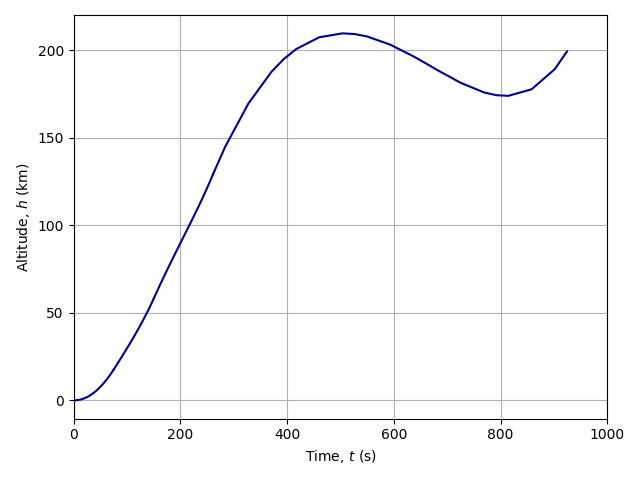
Altitude
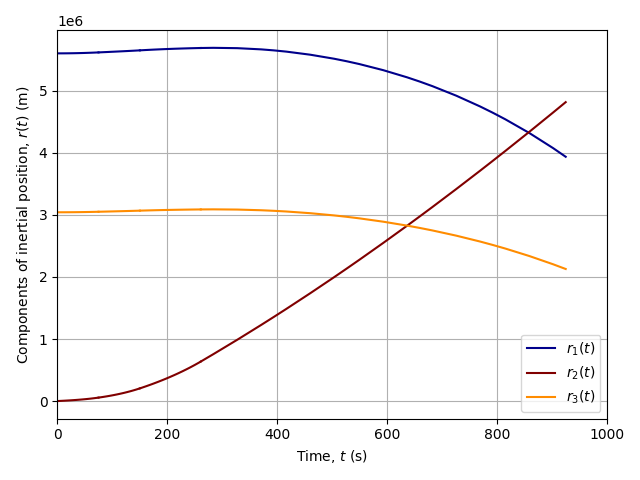
Vehicle Position Vector
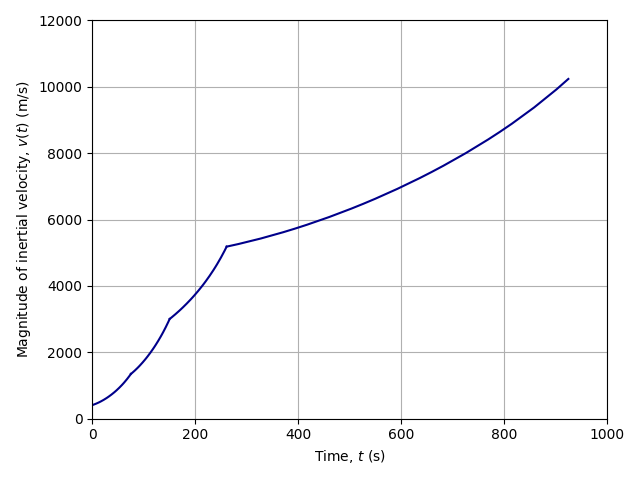
Total Vehicle Velocity
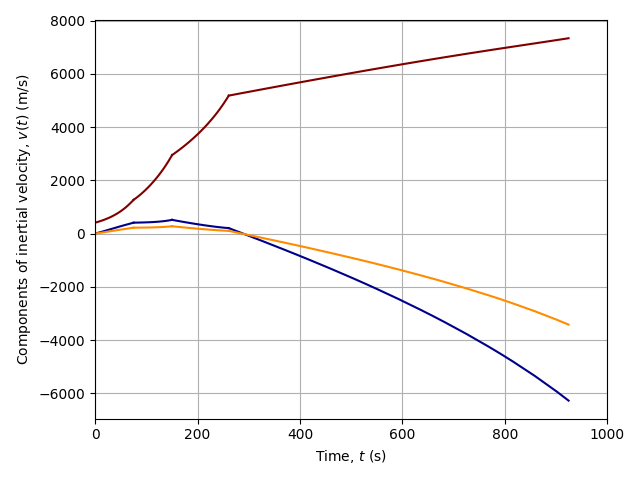
Vehicle Velocity Vector
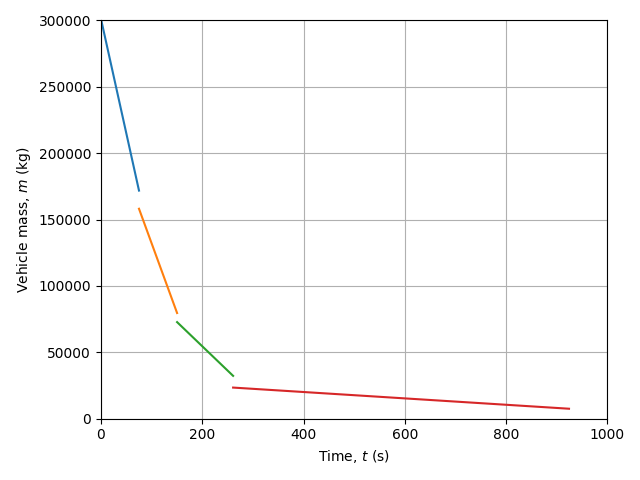
Vehicle Mass
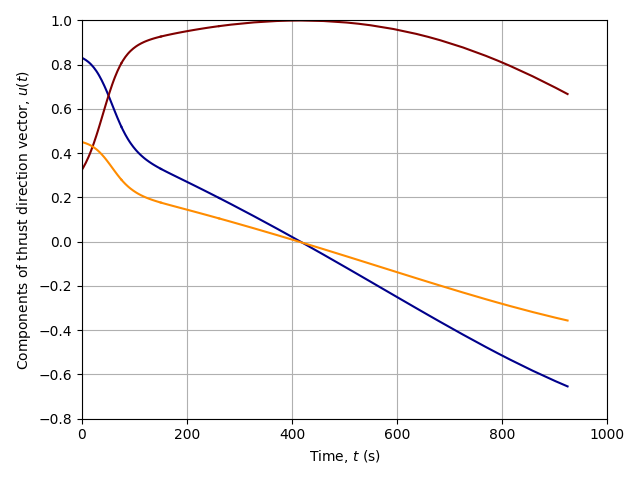
Control Inputs
Hamiltonian