The Goddard Problem (Three Phases)
For a description of the one-phase Goddard rocket problem, see the JupyterLab notebook documentation for this problem.
This problem has three phases because there is a singular arc in the solution. In the middle phase, the singular arc conditions are imposed as a path constraint. This results in a significantly better solution than the one-phase solution. See the one phase solution as a Python script or as a JupyterLab notebook.
This example script has user-defined methods for computing the first and second derivatives of the objective and continuous functions. User-defined derivatives can be faster to compute than derivatives computed by automatic differentiation, but not by a large factor. Because for most problems as much time is spent in the Ipopt solver as in derivative functions evaluation, even a substantial speedup in derivative evaluation may not result in a significant speedup in the overall solution time, and so it’s almost never worth the effort to implement user-defined derivatives.
The python script in this example can be executed from the command line with:
$ python -m yapss.examples.goddard_problem_3_phase
Functions
YAPSS solution of the Goddard rocket problem with three phases (one a singular arc).
Code
"""

YAPSS solution of the Goddard rocket problem with three phases (one a singular arc).

"""

# Allow uppercase variables
# ruff: noqa: N806

__all__ = ["main", "plot_solution", "setup"]

# third party imports
import matplotlib.pyplot as plt

from yapss import (
    ContinuousArg,
    ContinuousHessianArg,
    ContinuousJacobianArg,
    DiscreteArg,
    DiscreteHessianArg,
    DiscreteJacobianArg,
    ObjectiveArg,
    ObjectiveGradientArg,
    ObjectiveHessianArg,
    Problem,
    Solution,
)

# package imports
from yapss.math import exp


def setup() -> Problem:
    """Set up the Goddard Rocket Problem optimal control problem.

    Returns
    -------
    yapss.Problem:
        Optimal control problem object
    """
    ocp = Problem(
        name="Goddard Rocket Problem with Singular Arc",
        nx=[3, 3, 3],
        nu=[1, 1, 1],
        nh=[0, 1, 0],
        nq=[0, 0, 0],
        nd=8,
    )

    # callback functions
    def objective(arg: ObjectiveArg) -> None:
        """Goddard Rocket Problem objective function."""
        arg.objective = arg.phase[2].final_state[0]

    def objective_gradient(arg: ObjectiveGradientArg) -> None:
        """Gradient of Goddard Rocket Problem objective function."""
        arg.gradient[(2, "xf", 0)] = 1

    def objective_hessian(_: ObjectiveHessianArg) -> None:
        """Hessian of Goddard Rocket Problem objective function."""

    # noinspection PyPep8Naming
    def continuous(arg: ContinuousArg) -> None:
        """Goddard Rocket Problem dynamics and path functions."""
        auxdata = arg.auxdata
        sigma = auxdata.sigma
        h0 = auxdata.h0
        c = auxdata.c
        g0 = auxdata.g
        for p in arg.phase_list:
            (h, v, mass) = arg.phase[p].state
            (T,) = arg.phase[p].control
            D = sigma * v**2.0 * exp(-h / h0)
            h_dot = v
            v_dot = (T - D) / mass - g0
            m_dot = -T / c
            arg.phase[p].dynamics[:] = (h_dot, v_dot, m_dot)

            if p == 1:
                arg.phase[p].path[:] = (mass * g0 - (1 + v / c) * D,)

    # noinspection PyPep8Naming,PyPep8Naming,PyPep8Naming,PyPep8Naming
    def continuous_jacobian(arg: ContinuousJacobianArg) -> None:
        """Jacobian of Goddard Rocket Problem dynamics and path functions."""
        auxdata = arg.auxdata
        sigma = auxdata.sigma
        h0 = auxdata.h0
        c = auxdata.c
        g0 = auxdata.g

        for p in arg.phase_list:
            h, v, mass = arg.phase[p].state
            (T,) = arg.phase[p].control
            D_div_v2 = sigma * exp(-h / h0)
            D_div_v = D_div_v2 * v
            D = D_div_v * v

            jacobian = arg.phase[p].jacobian
            jacobian[("f", 0), ("x", 1)] = 1
            jacobian[("f", 1), ("x", 0)] = D / (h0 * mass)
            jacobian[("f", 1), ("x", 1)] = -2 * D_div_v / mass
            jacobian[("f", 1), ("x", 2)] = -(T - D) / mass**2
            jacobian[("f", 1), ("u", 0)] = 1 / mass
            jacobian[("f", 2), ("u", 0)] = -1 / c

            if p == 1:
                jacobian[("h", 0), ("x", 0)] = D * (1 + v / c) / h0
                jacobian[("h", 0), ("x", 1)] = D * (-3 / c) - 2 * D_div_v
                jacobian[("h", 0), ("x", 2)] = g0

    # noinspection PyPep8Naming
    def continuous_hessian(arg: ContinuousHessianArg) -> None:
        """Hessian of Goddard Rocket Problem dynamics and path functions."""
        auxdata = arg.auxdata
        sigma = auxdata.sigma
        h0 = auxdata.h0
        c = auxdata.c

        for p in arg.phase_list:
            h, v, mass = arg.phase[p].state
            (T,) = arg.phase[p].control
            D_div_v2 = sigma * exp(-h / h0)
            D_div_v = D_div_v2 * v
            D = D_div_v * v

            hessian = arg.phase[p].hessian
            hessian[("f", 1), ("x", 0), ("x", 0)] = -D / (h0**2 * mass)
            hessian[("f", 1), ("x", 0), ("x", 1)] = 2 * D_div_v / (h0 * mass)
            hessian[("f", 1), ("x", 0), ("x", 2)] = -D / (h0 * mass**2)
            hessian[("f", 1), ("x", 1), ("x", 1)] = -2 * D_div_v2 / mass
            hessian[("f", 1), ("x", 1), ("x", 2)] = 2 * D_div_v / mass**2
            hessian[("f", 1), ("x", 2), ("x", 2)] = 2 * (T - D) / mass**3
            hessian[("f", 1), ("x", 2), ("u", 0)] = -1 / mass**2

            if p == 1:
                hessian[("h", 0), ("x", 0), ("x", 0)] = -D * (c + v) / (c * h0**2)
                hessian[("h", 0), ("x", 0), ("x", 1)] = D_div_v * (2 * c + 3 * v) / (c * h0)
                hessian[("h", 0), ("x", 1), ("x", 1)] = -2 * D_div_v2 * (c + 3 * v) / c

    def discrete(arg: DiscreteArg) -> None:
        """Goddard Rocket Problem discrete constraint function."""
        phase = arg.phase
        arg.discrete = [
            phase[0].final_time - phase[1].initial_time,
            *(phase[0].final_state - phase[1].initial_state),
            phase[1].final_time - phase[2].initial_time,
            *(phase[1].final_state - phase[2].initial_state),
        ]

    def discrete_jacobian(arg: DiscreteJacobianArg) -> None:
        """Jacobian of Goddard Rocket Problem discrete constraint function."""
        jac = arg.jacobian
        jac[0, (0, "tf", 0)] = 1
        jac[0, (1, "t0", 0)] = -1
        jac[1, (0, "xf", 0)] = 1
        jac[1, (1, "x0", 0)] = -1
        jac[2, (0, "xf", 1)] = 1
        jac[2, (1, "x0", 1)] = -1
        jac[3, (0, "xf", 2)] = 1
        jac[3, (1, "x0", 2)] = -1
        jac[4, (1, "tf", 0)] = 1
        jac[4, (2, "t0", 0)] = -1
        jac[5, (1, "xf", 0)] = 1
        jac[5, (2, "x0", 0)] = -1
        jac[6, (1, "xf", 1)] = 1
        jac[6, (2, "x0", 1)] = -1
        jac[7, (1, "xf", 2)] = 1
        jac[7, (2, "x0", 2)] = -1

    def discrete_hessian(_: DiscreteHessianArg) -> None:
        """Hessian of Goddard Rocket Problem discrete constraint function."""

    # Initial conditions
    h0 = 0
    v0 = 0
    m0 = 3
    mf = 1

    # physical constants
    ocp.auxdata.Tm = Tm = 193.044
    ocp.auxdata.g = 32.174
    ocp.auxdata.sigma = 5.49153484923381010e-05
    ocp.auxdata.c = 1580.9425279876559
    ocp.auxdata.h0 = 23800

    # user functions
    ocp.functions.continuous = continuous
    ocp.functions.continuous_jacobian = continuous_jacobian
    ocp.functions.continuous_hessian = continuous_hessian
    ocp.functions.objective = objective
    ocp.functions.objective_gradient = objective_gradient
    ocp.functions.objective_hessian = objective_hessian
    ocp.functions.discrete = discrete
    ocp.functions.discrete_jacobian = discrete_jacobian
    ocp.functions.discrete_hessian = discrete_hessian

    # begin bounds: phase 0
    bounds = ocp.bounds.phase[0]
    bounds.initial_time.lower = bounds.initial_time.upper = 0
    bounds.initial_state.lower[:] = bounds.initial_state.upper[:] = h0, v0, m0
    bounds.control.lower[:] = bounds.control.upper[:] = Tm

    for p in range(3):
        ocp.bounds.phase[p].state.lower[:] = h0, v0, mf
        ocp.bounds.phase[p].state.upper[:] = 20000, 10000, m0

    # ... phase 1
    bounds = ocp.bounds.phase[1]
    bounds.control.lower[:] = 0.01 * Tm
    bounds.control.upper[:] = 0.99 * Tm
    bounds.path.lower[:] = 0
    bounds.path.upper[:] = 0
    # ... phase 2
    bounds = ocp.bounds.phase[2]
    bounds.final_state.lower[2] = bounds.final_state.upper[2] = mf
    bounds.final_state.lower[1] = 0
    bounds.final_state.upper[1] = float("inf")
    bounds.control.lower[:] = bounds.control.upper[:] = 0

    ocp.bounds.discrete.lower[:] = 0
    ocp.bounds.discrete.upper[:] = 0

    # begin guess
    for p in range(3):
        ocp.guess.phase[p].time = [15 * p, 15 * (p + 1)]
        ocp.guess.phase[p].state = [
            (6000 * p, 6000 * (p + 1)),
            (500, 500),
            (3 - 2 / 3 * p, 3 - 2 / 3 * (p + 1)),
        ]
        ocp.guess.phase[p].control = [(Tm * (2 - p) / 2, Tm * (2 - p) / 2)]

    ocp.scale.objective = -1

    # solver options
    ocp.derivatives.order = "second"
    ocp.derivatives.method = "auto"
    ocp.spectral_method = "lgl"

    # ipopt options
    ocp.ipopt_options.max_iter = 500
    ocp.ipopt_options.tol = 1e-20
    ocp.ipopt_options.print_level = 3

    return ocp


def plot_solution(solution: Solution) -> None:
    """Plot solution of the Goddard Rocket Problem.

    Parameters
    ----------
    solution : Solution
        The solution to the Goddard Rocket Problem.
    """
    # extract information from solution
    time = []
    time_c = []
    state = []
    control = []
    costate = []
    dynamics = []
    integrand = []

    for p in range(3):
        time.append(solution.phase[p].time)
        time_c.append(solution.phase[p].time_c)
        state.append(solution.phase[p].state)
        control.append(solution.phase[p].control)
        costate.append(solution.phase[p].costate)
        dynamics.append(solution.phase[p].dynamics)
        integrand.append(solution.phase[p].integrand)

    t0 = time[0][0]
    tf = time[2][-1]

    # thrust
    plt.figure(1)
    ax = plt.axes()
    line = []
    for p in range(3):
        line1 = ax.plot(time_c[p], control[p][0])
        line.append(line1)
    plt.ylabel("Thrust, $T$ (lbf)")

    # altitude
    plt.figure(2)
    ax = plt.axes()
    line = []
    for p in range(3):
        line1 = ax.plot(time[p], state[p][0])
        line.append(line1)
    plt.ylabel("Altitude, $h$ (ft)")

    # velocity
    plt.figure(3)
    ax = plt.axes()
    line = []
    for p in range(3):
        line1 = ax.plot(time[p], state[p][1])
        line.append(line1)
    plt.ylabel("Velocity, $v$ (ft/s)")

    # mass
    plt.figure(4)
    ax = plt.axes()
    line = []
    for p in range(3):
        line1 = ax.plot(time[p], state[p][2])
        line.append(line1)
    plt.ylabel("Mass, $m$ (slugs)")

    # hamiltonian
    plt.figure(5)
    ax = plt.axes()
    line = []
    for p in range(3):
        hamiltonian = sum(dynamics[p][i] * costate[p][i] for i in range(3))
        line1 = ax.plot(time_c[p], hamiltonian)
        line.append(line1)
    plt.ylim([-0.01, 0.01])
    plt.ylabel(r"Hamiltonian, $\mathcal{H}")

    for i in range(1, 6):
        plt.figure(i)
        plt.legend(("Phase 1", "Phase 2", "Phase 3"), framealpha=1.0)
        plt.xlabel("Time, $t$ (sec)")
        plt.xlim([t0, tf])
        plt.tight_layout()
        plt.grid()


def main() -> None:
    """Demonstrate the solution to the Goddard Rocket Problem (3 phases)."""
    problem = setup()
    solution = problem.solve()
    plot_solution(solution)
    plt.show()


if __name__ == "__main__":
    main()
Text Output
******************************************************************************
This program contains Ipopt, a library for large-scale nonlinear optimization.
 Ipopt is released as open source code under the Eclipse Public License (EPL).
         For more information visit https://github.com/coin-or/Ipopt
******************************************************************************

Total number of variables............................:     1001
                     variables with only lower bounds:        0
                variables with lower and upper bounds:      906
                     variables with only upper bounds:        0
Total number of equality constraints.................:      999
Total number of inequality constraints...............:        3
        inequality constraints with only lower bounds:        3
   inequality constraints with lower and upper bounds:        0
        inequality constraints with only upper bounds:        0


Number of Iterations....: 31

                                   (scaled)                 (unscaled)
Objective...............:  -1.8550871863824483e+04    1.8550871863824483e+04
Dual infeasibility......:   1.2732925824820995e-11    1.2732925824820995e-11
Constraint violation....:   1.2123564374633133e-09    1.2123564374633133e-09
Variable bound violation:   2.2204460492503131e-16    2.2204460492503131e-16
Complementarity.........:   9.9927165098521219e-16    9.9927165098521219e-16
Overall NLP error.......:   1.2123564374633133e-09    1.2123564374633133e-09


Number of objective function evaluations             = 34
Number of objective gradient evaluations             = 32
Number of equality constraint evaluations            = 34
Number of inequality constraint evaluations          = 34
Number of equality constraint Jacobian evaluations   = 32
Number of inequality constraint Jacobian evaluations = 32
Number of Lagrangian Hessian evaluations             = 31
Total seconds in IPOPT (w/o function evaluations)    =      0.780
Total seconds in NLP function evaluations            =      0.295

EXIT: Solved To Acceptable Level.
Plots
Thrust

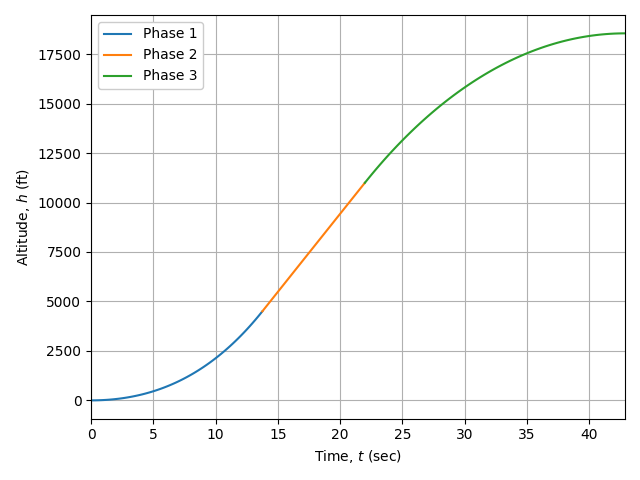
Altitude
Velocity

Mass

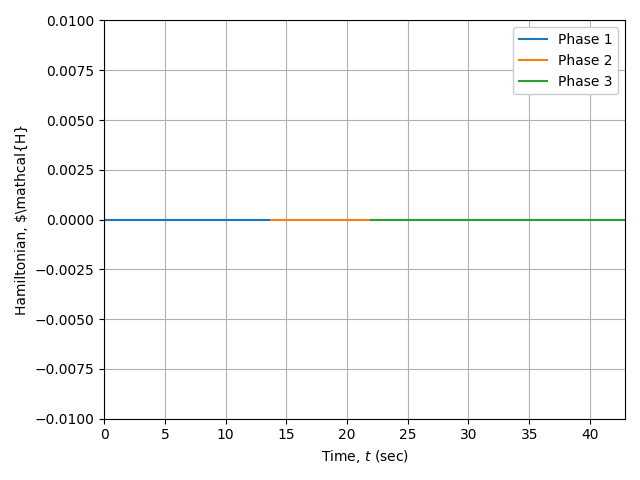
Hamiltonian