Dynamic Soaring
For a description of the dynamic soaring problem, see the dynamic soaring JupyterLab notebook documentation for this problem.
The python script in this example can be executed from the command line with:
$ python -m yapss.examples.dynamic_soaring
Functions
YAPSS solution of the dynamic soaring optimal control problem.
Code
"""

YAPSS solution of the dynamic soaring optimal control problem.

"""

__all__ = ["main", "plot_solution", "setup"]

from typing import TYPE_CHECKING

# third party imports
import matplotlib.pyplot as plt

# package imports
import numpy as np
from mpl_toolkits.mplot3d import Axes3D

from yapss import ContinuousArg, DiscreteArg, ObjectiveArg, Problem, Solution
from yapss.math import cos, sin

if TYPE_CHECKING:
    from numpy.typing import NDArray


def setup() -> Problem:
    """Set up the dynamic soaring optimal control problem.

    Returns
    -------
    Problem
        The dynamic soaring optimal control problem.
    """
    # initialize the optimal control problem
    ocp = Problem(name="Dynamic Soaring", nx=[6], nu=[2], nh=[1], ns=1, nd=3)

    # problem callback functions
    def objective(arg: ObjectiveArg) -> None:
        """Dynamic soaring objective function."""
        arg.objective = arg.parameter[0]

    def continuous(arg: ContinuousArg) -> None:
        """Dynamic soaring continuous function."""
        auxdata = arg.auxdata
        _, _, h, v, gamma, psi = arg.phase[0].state
        cl, phi = arg.phase[0].control
        beta = arg.parameter[0]

        w = auxdata.m * auxdata.g0
        q = auxdata.rho0 * v**2 / 2
        cd = auxdata.cd0 + auxdata.k * cl**2
        lift = q * auxdata.s * cl
        drag = q * auxdata.s * cd
        wx = beta * h + auxdata.w0

        cos_gamma = cos(gamma)
        sin_gamma = sin(gamma)
        cos_psi = cos(psi)
        sin_psi = sin(psi)
        cos_phi = cos(phi)
        sin_phi = sin(phi)

        x_dot = v * cos_gamma * sin_psi + wx
        y_dot = v * cos_gamma * cos_psi
        h_dot = v * sin_gamma
        wx_dot = beta * h_dot
        v_dot = -drag / auxdata.m - auxdata.g0 * sin_gamma - wx_dot * cos_gamma * sin_psi
        gamma_dot = lift * cos_phi - w * cos_gamma + auxdata.m * wx_dot * sin_gamma * sin_psi
        gamma_dot /= auxdata.m * v
        psi_dot = (lift * sin_phi - auxdata.m * wx_dot * cos_psi) / (auxdata.m * v * cos_gamma)

        arg.phase[0].dynamics[:] = x_dot, y_dot, h_dot, v_dot, gamma_dot, psi_dot
        arg.phase[0].dynamics[:] = x_dot, y_dot, h_dot, v_dot, gamma_dot, psi_dot
        arg.phase[0].path[:] = ((0.5 * auxdata.rho0 * auxdata.s / w) * cl * v**2,)

    def discrete(arg: DiscreteArg) -> None:
        """Dynamic soaring discrete function."""
        x0 = arg.phase[0].initial_state
        xf = arg.phase[0].final_state
        arg.discrete = xf[3:] - x0[3:]

    # user callback functions
    ocp.functions.objective = objective
    ocp.functions.continuous = continuous
    ocp.functions.discrete = discrete

    # define the auxiliary data
    auxdata = ocp.auxdata
    auxdata.w0 = 0
    auxdata.g0 = 32.2
    auxdata.cd0 = 0.00873
    auxdata.rho0 = 0.002378
    auxdata.m = 5.6
    auxdata.s = 45.09703
    auxdata.k = 0.045
    auxdata.cl_max = 1.5

    # set bounds
    bounds = ocp.bounds.phase[0]
    bounds.initial_time.lower = 0
    bounds.initial_time.upper = 0
    bounds.final_time.lower = 10
    bounds.final_time.upper = 30
    bounds.initial_state.lower[:3] = bounds.initial_state.upper[:3] = 0, 0, 0
    bounds.final_state.lower[:3] = bounds.final_state.upper[:3] = 0, 0, 0
    bounds.state.lower = -1500, -1000, 0, 10, np.radians(-75), np.radians(-225)
    bounds.state.upper = +1500, +1000, 1000, 350, np.radians(75), np.radians(225)
    bounds.control.lower = 0, np.radians(-75)
    bounds.control.upper = auxdata.cl_max, np.radians(75)
    bounds.path.lower = (-2,)
    bounds.path.upper = (5,)
    ocp.bounds.discrete.lower = ocp.bounds.discrete.upper = 0, 0, np.radians(360)

    # scaling to improve convergence rate
    scale = ocp.scale
    scale.objective = 0.1
    scale.parameter = [0.1]
    scale.discrete = [200.0, 200.0, 200.0]
    phase = scale.phase[0]
    phase.dynamics = phase.state = 1000.0, 1000.0, 1000.0, 200.0, 1.0, 6.0
    phase.control = 1.0, 1.0
    phase.time = 30.0
    phase.path = [7.0]

    # generate guess
    pi = np.pi
    tf = 24
    one: NDArray[np.float64] = np.ones(50, dtype=float)
    t: NDArray[np.float64] = np.linspace(0, tf, num=50, dtype=float)
    y = -200 * np.sin(2 * pi * t / tf)
    x = 600 * (np.cos(2 * pi * t / tf) - 1)
    h = -0.7 * x
    v = 150 * one
    gamma = 0 * one
    psi = np.radians(t / tf * 360)
    cl = 0.5 * one
    phi = np.radians(45) * one

    ocp.guess.phase[0].time = t
    ocp.guess.phase[0].state = x, y, h, v, gamma, psi
    ocp.guess.phase[0].control = cl, phi
    ocp.guess.parameter = (0.08,)

    # define a fairly dense mesh to capture discontinuity in derivatives
    m, n = 50, 6
    ocp.mesh.phase[0].collocation_points = m * (n,)
    ocp.mesh.phase[0].fraction = m * (1.0 / m,)
    ocp.spectral_method = "lgl"

    # define derivatives
    ocp.derivatives.method = "auto"
    ocp.derivatives.order = "second"

    # ipopt options
    ocp.ipopt_options.max_iter = 500
    ocp.ipopt_options.print_level = 3

    return ocp


def plot_solution(solution: Solution) -> None:
    """Plot the solution to the dynamic soaring optimal control problem.

    Parameters
    ----------
    solution : Solution
        The solution to the dynamic soaring optimal control problem.
    """
    # extract information from solution
    auxdata = solution.problem.auxdata
    t = solution.phase[0].time
    tc = solution.phase[0].time_c
    x, y, h, v, gamma, psi = solution.phase[0].state
    cl, phi = solution.phase[0].control
    hamiltonian = solution.phase[0].hamiltonian

    # figure 1: plot the path in 3D
    plt.figure(1)
    ax: Axes3D = plt.axes(projection=Axes3D.name)
    ax.plot3D(x, y, h)
    ax.plot3D(0 * x - 1200, y, h, "r--")
    ax.plot3D(x, 0 * y + 500, h, "r--")
    ax.plot3D(x, y, 0 * h - 100, "r--")
    ax.set_xlim([-1200, 0])
    ax.set_ylim([-600, 500])
    ax.set_zlim([-100, 1000])
    ax.set_xlabel(r"$x$ (ft)")
    ax.set_ylabel(r"$y$ (ft)")
    ax.set_zlabel(r"$h$ (ft)")
    plt.tight_layout()

    # figure 2: Lift coefficient
    plt.figure(2)
    limit = 5 * (auxdata.m * auxdata.g0) / (0.5 * auxdata.rho0 * auxdata.s * v**2)
    plt.plot(t, limit, "r--")
    plt.plot(tc, cl)
    plt.ylim([0, 1])
    legend = plt.legend(["Load factor limit", "Lift coefficient, $C_{L}$"])
    legend.get_frame().set_facecolor("white")
    legend.get_frame().set_alpha(1)
    legend.get_frame().set_linewidth(0)
    plt.ylabel(r"Lift coefficient, $C_L$")

    # figure 3: velocity
    plt.figure(3)
    plt.plot(t, v)
    plt.ylabel(r"Velocity, $v$ (ft/s)")

    # figure 4: gamma
    plt.figure(4)
    plt.plot(t, np.rad2deg(gamma))
    plt.ylabel(r"Flight path angle, $\gamma$ (deg)")

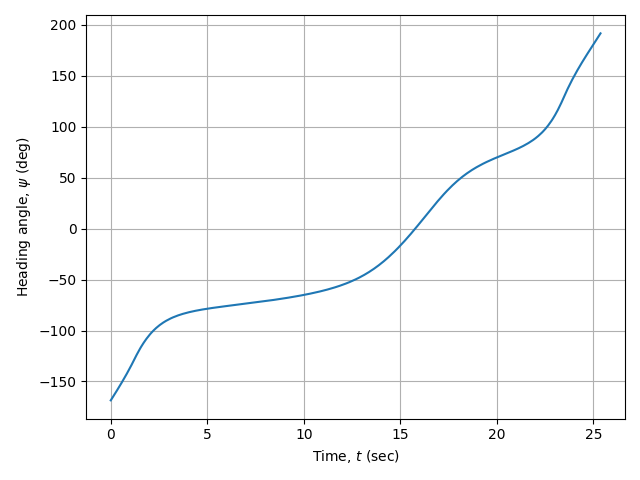
    # figure 5: psi
    plt.figure(5)
    plt.plot(t, np.rad2deg(psi))
    plt.ylabel(r"Heading angle, $\psi$ (deg)")

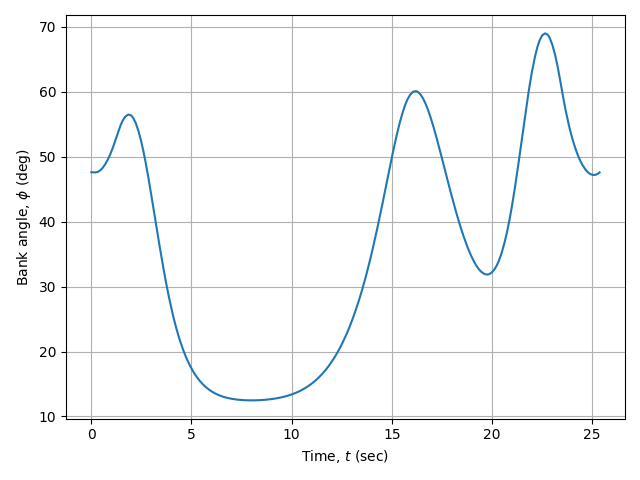
    # figure 6: bank angle
    plt.figure(6)
    plt.plot(tc, np.rad2deg(phi))
    plt.ylabel(r"Bank angle, $\phi$ (deg)")

    # figure 7: Hamiltonian
    plt.figure(7)
    plt.plot(tc, hamiltonian)
    plt.ylabel(r"Hamiltonian, $\mathcal{H}$")
    plt.ylim([-0.01, 0.01])

    for i in range(2, 8):
        plt.figure(i)
        plt.xlabel(r"Time, $t$ (sec)")
        plt.tight_layout()
        plt.grid()


def main() -> None:
    """Demonstrate the solution to the dynamic soaring optimal control problem."""
    problem = setup()
    solution = problem.solve()
    plot_solution(solution)
    plt.show()


if __name__ == "__main__":
    main()
Text Output
******************************************************************************
This program contains Ipopt, a library for large-scale nonlinear optimization.
 Ipopt is released as open source code under the Eclipse Public License (EPL).
         For more information visit https://github.com/coin-or/Ipopt
******************************************************************************

Total number of variables............................:     2304
                     variables with only lower bounds:        0
                variables with lower and upper bounds:     2003
                     variables with only upper bounds:        0
Total number of equality constraints.................:     1803
Total number of inequality constraints...............:      252
        inequality constraints with only lower bounds:        1
   inequality constraints with lower and upper bounds:      251
        inequality constraints with only upper bounds:        0


Number of Iterations....: 32

                                   (scaled)                 (unscaled)
Objective...............:   6.3586558207092936e-01    6.3586558207092941e-02
Dual infeasibility......:   1.8260011056998176e-13    1.8260011056998176e-14
Constraint violation....:   9.3851176830028749e-11    4.7944936909516400e-10
Variable bound violation:   0.0000000000000000e+00    0.0000000000000000e+00
Complementarity.........:   1.0051386917517832e-11    1.0051386917517832e-12
Overall NLP error.......:   9.3851176830028749e-11    4.7944936909516400e-10


Number of objective function evaluations             = 33
Number of objective gradient evaluations             = 33
Number of equality constraint evaluations            = 33
Number of inequality constraint evaluations          = 33
Number of equality constraint Jacobian evaluations   = 33
Number of inequality constraint Jacobian evaluations = 33
Number of Lagrangian Hessian evaluations             = 32
Total seconds in IPOPT (w/o function evaluations)    =      2.471
Total seconds in NLP function evaluations            =      0.630

EXIT: Optimal Solution Found.
Plots
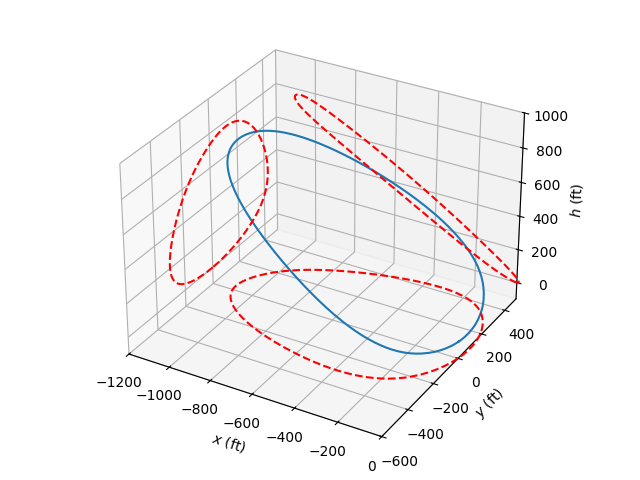
Optimal Trajectory
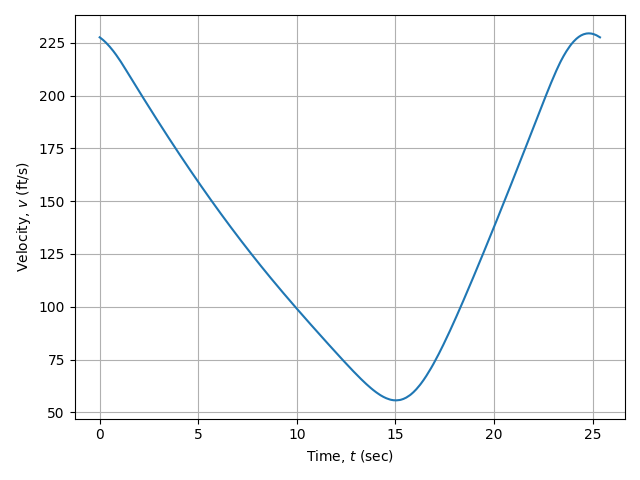
Velocity
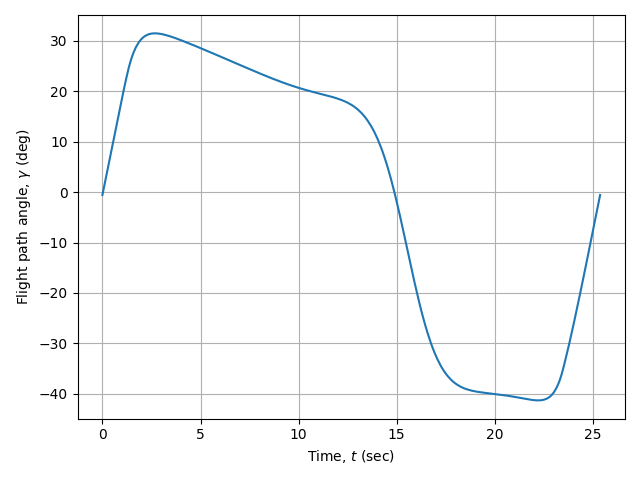
Flight Path Angle
Heading Angle
Lift Coefficient

Bank Angle
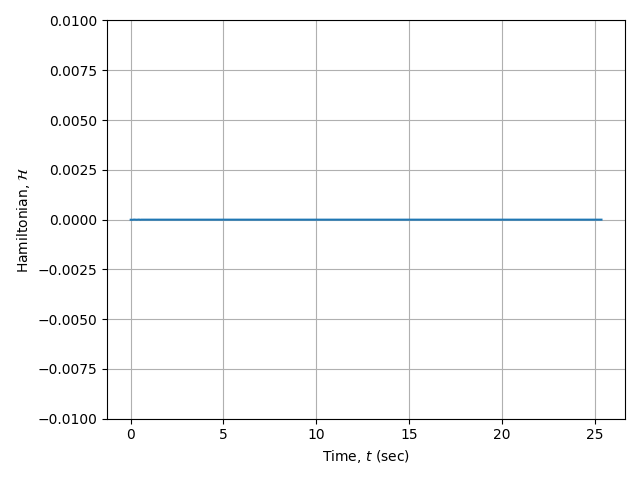
Hamiltonian